
The City Hall of Ponte Alta approved a food purchase that its own Prosecutor disapproved.On April 13, 2026, Mayor Edson Julio Wolinger authorized, after the Secretary of Administration and Finance, the Contracting Agent, and the Municipality's Prosecutor had writtenly disapproved the quantities, a food purchase for six secretariats that the July tender closed at R$ 1,961,115.85, and the first purchases, made in August, served secretariats that do not provide school meals, the only one for which the Prosecutor had fully approved the purchase.
Ponte Alta is a small city in the Santa Catarina Mountains, with an estimated population of 4,430 in 2024 by the Brazilian Institute of Geography and Statistics (IBGE), without a public hospital and with two basic health units, and the process, opened on February 3, 2026, grouped the six secretariats in a single request: the estimated value was R$ 2,377,016.41 in the April technical study and R$ 2,053,029.94 in the July tender, and the result of the tender amounts to approximately R$ 443 per resident, for food only, in a year.
The resistance to this purchase was documented within the City Hall: three municipal public servants, one after the other, pointed out in writing that the numbers did not add up.
The first was the Secretary of Administration and Finance, Sílvio Girardi, who, in an internal communication on March 20, 2026, informed the Licensing Sector that he refused to sign the Preliminary Technical Study, the Risk Map, and the Demand Formalization for the Health purchase because, in his words, the quantities had "no plausible basis."
... they are not capable of consuming 150kg of avocado, 150kg of powdered saffron, 70kg of cornstarch, and over 1 (one) ton of meat per year.
The second was the Contracting Agent, Gianini Mattge Silveira Largura, who, in a March 31 dispatch, returned the files to the Health Secretariat and ordered the quantities to be corrected to reflect "the real demand of the requesting units."
The third was the Municipality's Prosecutor, Gabriel Bernardes de Almeida, the harshest of the three: in a April 7 opinion, he wrote that the justification presented by Health Secretary Sandra Rodrigues "border[ed] on absurdity," and concluded that it was impossible for the Health, Agriculture, and Social Assistance Secretariats to participate in the purchase, except for basic items like water, coffee, sugar, and milk. Only Education, for school meals for students, had support, in his interpretation.
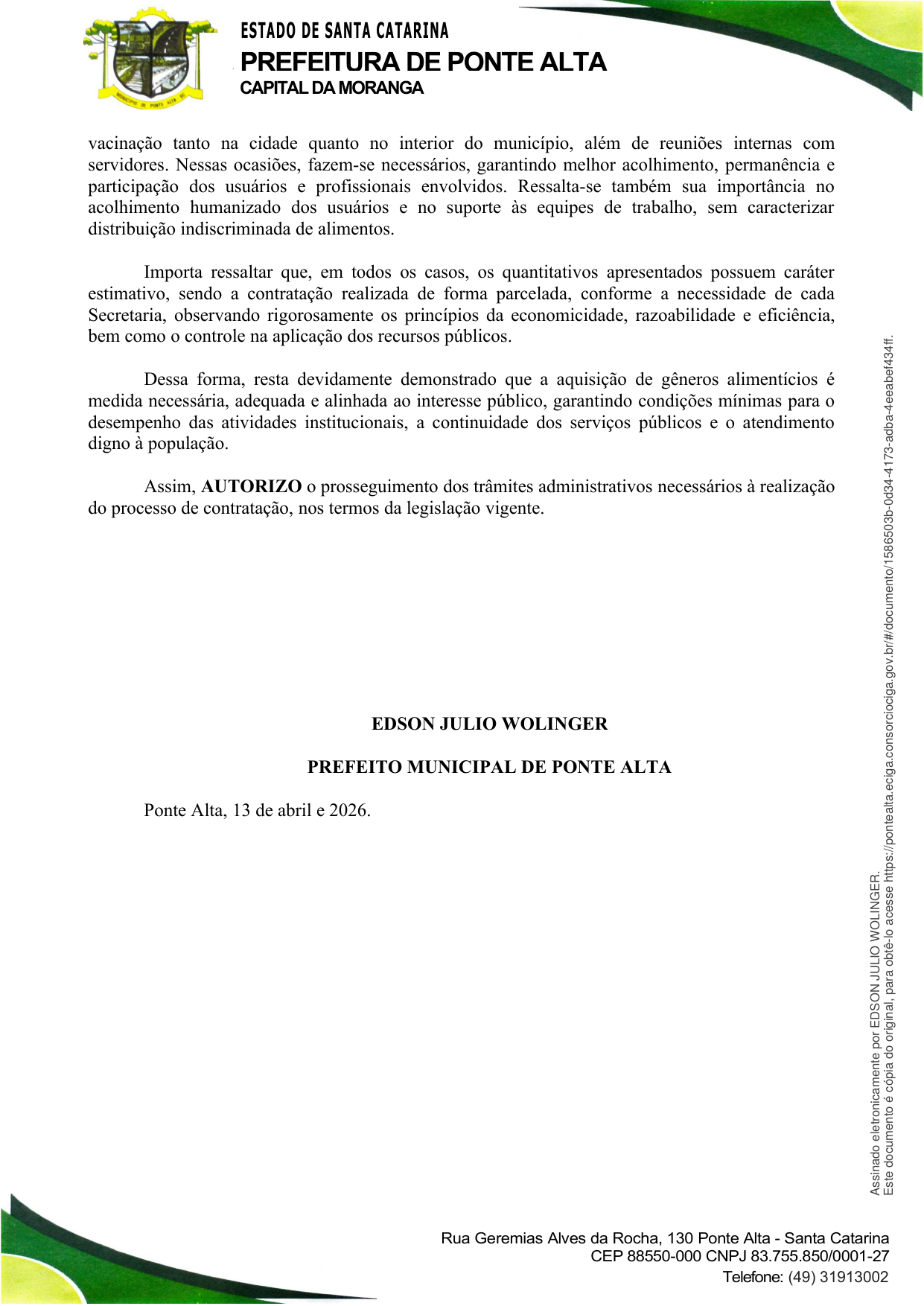
Six days later, on April 13th, Ponte Alta Mayor Edson Julio Wolinger made a contrary decision: in his own dispatch, he rebutted the city prosecutor's opinion point by point, argued that the quantities were estimates and the purchase would be spread across payments as needed, and authorized the process to continue. There is no supporting legal second opinion in the case files, as the only opinion presented was the one he disagreed with.
The tender: two bidders with equal proposals to the reference price
The Mayor's authorization was sent to the tender: the National Public Contractations Portal (PNCP) records Tender No. 17/2026 as an electronic tender in a price registration system, published on July 16th, with proposals received until July 30th, 2026. Between the technical study in April and the tender in July, the estimate dropped by R$ 323,986.47, and the reporter has not yet located the document explaining the cut.
The meeting minutes, published on PNCP on August 7th, show a competition with only two bidders, a Ponte Alta supermarket and another from Correia Pinto, authors of two of the three budgets that served as a reference for the tender price; the third budget, from a second supermarket in Correia Pinto, did not result in a proposal. Out of the 80 lots for which the initial proposal in the minutes can be read, in 79 the two bidders started with the exact reference price, cent by cent, and the discount came only in the bidding phase: the median was 3%, and the overall result, R$ 1,961,115.85, was 4.5% below the tender estimate. The Ponte Alta supermarket secured 79 items (R$ 993,032.16) and the Correia Pinto supermarket 95 (R$ 968,083.69); one item, white raisins, failed. The Ponte Alta supermarket expressed the intention to appeal, "due to the eligibility documents," on dozens of lots lost to the competitor, and the adjudication of all lots took place on the same morning of August 7th; the outcome of these appeals is not recorded in the meeting minutes.
On August 11th, 2026, the City Hall signed Price Registration Minutes No. 10 and No. 11/2026, one for each supermarket, valid until August 11th, 2027. Price registration is not a closed purchase: the money is released only with each order issued by a city department, which is why the Mayor's defense, that the purchase would be spread across payments as needed, has merit with the chosen instrument. What the minutes guarantee for both suppliers is the right to sell, at the registered prices, up to the limit of each item, for one year.
The quantities are only known by those who consume them in school meals.
When summed, the volumes reach at least eleven tons of meat, approximately 10,800 liters of milk, and 270 kilograms of powdered saffron per year, and what determines if they are excessive is the consumer.
If the consumer is the school meal, the numbers shrink: the municipal network has five schools and 530 enrollments in the 2025 School Census, including daycare, pre-school, and elementary education, and divided among these students over 200 school days, the calculation results in a common meal: around 100 grams of protein and 100 milliliters of milk per student per day, and just over 2 grams of saffron, which, at R$15.00 per kilogram, is the coloring agent in the kitchen, not the rare product that its name suggests.
The problem is that the denominator only exists for school meals, because the other secretariats do not have a population that eats a daily meal. Health does not serve lunch to anyone, it attends campaigns, groups, and meetings, and yet it is the secretariat with the largest share of the process value; Agriculture has thirteen employees; Social Assistance serves approximately 135 people at the Social Assistance Reference Center - CRAS, which, according to its own report, already receive baskets through other two processes. This was the point made by the technicians: a single process involved six secretariats, and the shares of secretariats without a consumer hid behind the legitimate and voluminous share of school meals.
The first requests were sent to secretariats that do not serve meals.
The Municipality's Transparency Portal, with updated data on September 10, records the first requests made based on the minutes: on August 17, six days after the signature, food item commitments were made to the Secretariat of Administration, the Secretariat of the Environment, the Secretariat of Social Assistance, and CRAS, and the next day to the Mayor's Office and two supermarkets. The values are small so far, around R$30,000 in total in commitments already read, but the destination of these requests is what matters: among the first purchases are those of Social Assistance and CRAS, which the Prosecutor had excluded, and those of Administration, Environment, and the Mayor's Office, sectors without a daily meal to serve.
The same portal helps to measure what the city had already spent on these two suppliers: in 2024, the City Hall and the Municipal Health Fund paid approximately R$1.66 million to these two supermarkets, and in 2025 around R$1.42 million, considering everything purchased there, from food to cleaning materials. The price register of R$1.96 million only for food items is therefore in the same order of magnitude as what the city had already paid annually to these two suppliers for everything purchased there, and this data is useful both for the Mayor's defense, that nothing new was created, and for the technicians' question, of who consumes so much.
The reference prices came from retail budgets, two of them from the actual winners.
There is a second issue under investigation: the reference price exceeded the average of three supermarket budgets, one from Ponte Alta and two from neighboring Correia Pinto, and public purchases of this size typically seek wholesale prices. Using the retail shelf price tends to inflate the estimate, as most of the money is spent on beef, which accounts for nearly a quarter of a million reais. The fact that both winners started exactly at the reference price, and that this price was calculated from their own budgets, is the data that demands the most explanation.
There is an example that jumps to the eye: 500-gram coffee powder entered at R$ 41.03, above what popular brands cost in retail. However, comparing food prices across different markets leads to errors, as shipping and tax regimes vary, and the only serious comparison this investigation will make is against the official and neutral Federal Government Price Panel, item by item, before claiming any markup. What can already be said, from the records, is that the estimate was based on retail shelf prices, not wholesale, and it is from the wholesale sector that a public purchase of this size should originate.
The official who refused the purchase was exonerated, and the Autism Institute he helped establish had its funding delayed.
The food purchase in Ponte Alta intersects with another case this author covered in a video report published on September 30: that of the Autism Institute, which the city hall announced on its website on September 13, 2025, and inaugurated on October 8 of that year. The origin of this Institute is the same Silvio Girardi, who, as Secretary of Administration and Finance, refused to sign the purchase for Health. According to the report, Girardi and his wife, Cristiane Meurer, orchestrated with the city hall the implementation of the Institute, linked to the Catarinense Social and Educational Support Association to Families (ACASEF) from Lages, and they are now in charge of its management in Ponte Alta.
The link between the official and the Institute is also official: according to Municipal Decree No. 422/2026, dated August 24, 2026, from Ponte Alta City Hall, signed by the Mayor and published in the Official Journal of Municipal Governments of Santa Catarina (DOM/SC) on September 15, Municipal Decree No. 060/2026, dated January 28, 2026, from the same City Hall, had designated Girardi, still as Secretary, as manager of partnerships the municipality would establish with ACASEF and two intermunicipal consortia. Municipal Decree No. 422/2026 ceased this designation effective April 13, 2026, the date of the Mayor's dispatch authorizing the purchase against the Prosecutor's opinion. The report did not locate, as of publication, the act that exonerated Girardi from his post as Secretary, and thus cannot assert the date he left the office.
Both parties confirm Girardi was exonerated, but differ on the reason. To the reporter, Girardi recounted being called to an urgent meeting in the cabinet with other secretaries and being held accountable for not having approved the food bidding process, including by Health Secretary Sandra Rodrigues, whom he had questioned about the requested meat quantity, and that he refused to sign (video, from 9:52). Mayor Edson Julio Wolinger gave another reason, incompetence, and unannounced recordings of administration meetings, and denied any political rift with the former Secretary (video, from 13:21). Asked about the purchase Girardi had refused to sign, the Mayor responded, "It doesn't even exist" (video, 14:43). The documents from Process No. 17/2026, reproduced above, show the purchase existed and was authorized by him on April 13.
The Institute's funding delay emerged in September 2026, when professionals reported to the report that the city had not transferred the funds covering the free services for families, in neurology, psychology, neuropsychology, pedagogic psychology, nutrition, physiotherapy, and occupational therapy (video, from 2:39). The Mayor himself confirmed the delay in a video posted on social media in the same month: he said the municipality pays up to the 17th of each month, and that month it hadn't paid because he received "indications, allegations of irregularities at the Institute," including hiring staff without experience with autistic individuals and soft drink receipts, and announced a written investigation (video, from 4:50). Physiotherapist Felipe Silveira de Moraes stated all service providers were registered with their respective councils, and Institute President Alex Marcelo Amaral da Silva explained the meals were for professionals coming from Lages; however, ACASEF's note stated the interviewed professionals were not authorized to speak on the Institute's behalf (video, from 5:32).
Girardi and Cristiane Meurer informed the report by phone they would hand over the Institute's management before October 17, the date set by the entity's presidency, as they understood they could not continue the work under those conditions (video, from 21:01). No document examined so far links one decision to the other, and this investigation does not assert that the funding delay is due to the former Secretary's refusal: what the records show is the same person at the center of both cases and the same date, April 13, 2026, in the dispatch authorizing the purchase and the end of Girardi's designation as manager of partnerships with ACASEF. The City Hall's version of the exoneration, the funding delay, and the announced investigation will be incorporated into this text.
What is still unknown
What is missing is the distinction between an irregularity and damage: how much of the minutes will be effectively requested and paid throughout the year, and if the recorded prices are above what the public administration pays for the same products. Until this is measured, what exists is a planning that the City Hall itself blocked three times, which the Mayor ordered to be followed, which became a tender with two bidders and identical proposals to the reference price, and whose initial purchases served sectors without daily meals to serve, including those excluded by the Prosecutor. That is why this investigation records the decisions taken and what has already been paid from them, leaving the conclusion about the damage for after the statements of the cited parties and the confrontation with the Price Panel.
To the people and bodies cited.The Unyielding invites the City Hall of Ponte Alta, Mayor Edson Julio Wolinger, Health Secretary Sandra Rodrigues, former Secretary of Administration and Finance Silvio Girardi, ACASEF, the two winning supermarkets of the tender, and all others cited to comment on the facts of this outline. The response, in full, will be incorporated into the article before any dissemination. Deadline for comment: two business days from receipt. Channel: insubornavel@mailbox.org.
Primary sources: Administrative Licensing Process PREFEITURA n.º 17/2026 (e-CIGA system); PNCP, purchase 83755850000127-1-000022/2026, with the Tender Performance Minutes and Price Registration Minutes nos. 10 and 11/2026; Ponte Alta Municipality Transparency Portal (data from 09/10/2026); City Hall Portaria n.º 422/2026 (DOM/SC, 15/09/2026); 2025 School Census (National Institute of Educational Studies and Research Anísio Teixeira — INEP, via QEdu). Public documents (art. 8, inc. IV, of Federal Law n.º 9.610/1998). Draft reserved, subject to correction after comments.
To be explored
Video report
Process documents
- Internal Memorandum No. 19/2026 from the Secretariat of Administration and Finance(March 20, 2026) — Full copy in the Insubornável archives; official record in the e-CIGA system, identifier 85594706-13c4-4e4a-bb68-4b7f0c9da7d4:https://pontealta.eciga.consorciociga.gov.br/#/document/85594706-13c4-4e4a-bb68-4b7f0c9da7d4(The document is marked internal; the record is public, but access to the file requires login).
- Mayor Edson Julio Wolinger's Dispatch(April 13, 2026) — Full copy in the archives; official record in e-CIGA, identifier 1586503b-0d34-4173-adba-4eeabef434ff:https://pontealta.eciga.consorciociga.gov.br/#/document/1586503b-0d34-4173-adba-4eeabef434ff.
- Administrative Licensing Process PREFEITURA No. 17/2026Public record of the entire process on e-CIGA, with the list of documents.
- Minutes of the Electronic Tender n.º 17/2026(August 7, 2026, 176 pages) — copy in the archives; it is from here that the two bidders emerge, the initial proposals equal to the reference price and the bids.
- Price Registration Minutes n.º 10/2026, Ponte Alta supermarketandPrice Registration Minutes n.º 11/2026, Correia Pinto supermarket(August 11, 2026) — copies in the archives; validity until August 11, 2027.
- Purchase 83755850000127-1-000022/2026 on PNCP— Edital, term of reference, meeting minutes, itemized results, and registration meeting records, from the official source.
- Portaria No. 422/2026 from the City Hall of Ponte Alta(August 24, 2026), Act No. 8704908 from the Official Journal of Municipalities of Santa Catarina, published on September 15, 2026 — terminates, effective April 13, 2026, the designation of Silvio Girardi as manager of partnerships with ACASEF.
Public sources for the numbers
- Ponte Alta Transparency Portal — Expenses by Creditor— Payments per year to the two winning supermarkets and the August and September 2026 obligations.
- Ponte Alta School Census 2025 (QEdu, INEP data)— The five schools and the 530 enrollments in the municipal network.
- Ponte Alta City Hall Contact Page— Electronic addresses of the Cabinet, Ombudsman, and Health and Education Secretariats used for request of manifestation.
Produced with Claude Fable 5 (Anthropic, AI), under the direction and responsibility of Daniel Goulart.
Style Note — The Unyielding writes with the capital letter of Classical Portuguese reverence and extends it to every profession prefixed with name: the Engineer, the Anthropologist, the Shoe Shine — at the same level as the Governor.